Kīlauea Eruption Status
Live Kīlauea eruption status & updates from the USGS Hawaiian Volcano Observatory. For informational & educational purposes only
Episode 54
Ended 35 days ago
Still no window for episode 55. USGS posts one once summit inflation gives them enough to forecast from.
Numerous rapid cycles of south vent overflows and drainback occurred overnight within Halema'uma'u crater at the summit of Kīlauea. The north and south vents had strong glow and intermittent spatter. There is no anomalous activity outside of the summit.
Last updated Tuesday, September 29, 2026, 9:02 AM HST(we check every 10 minutes)LIVESource: USGS Kīlauea Volcano. All data from USGS/HVO. Not affiliated with USGS.
✉️ Eruption email alerts
One email when Kīlauea's status actually changes, nothing else. Unsubscribe anytime.
How long the quiet usually lasts
USGS forecasts each episode from ground deformation. What they don't publish is how long the gaps have actually run, so here it is: 53 completed pauses since December 2024, drawn to scale.
Median pause
10 days
Shortest
16 hours
after Episode 1
Longest
30 days
after Episode 43
The spread is the point, not the median.
This pause so far: 34 days since Aug 25, 2026
Also on the island right now:Mauna Kea tonight: fairSurf: moderate on the south shoreVog: Moderate
📋 Activity Summary
- ▸Rapid cycles of south vent overflows and drainback occurred overnight in Halemaʻumaʻu
- ▸Forecast windows can no longer be modeled due to irregular ground tilt changes
- ▸Alert level remains at WATCH / ORANGE with heightened unrest
- ▸Episode 54 ended at 7:33 p.m. HST on August 25, 2026
Full USGS analysis
The north vent resumed precursory overflow activity on September 22. Overflows from the south vent began on September 27, and there have been over 80 short cycles of south vent overflows and lava draining back into the vent since last night at 7:44 p.m. HST. The north and south vents continued to glow and emit flames and intermittent spatter overnight. Strong continuous tremor dominates the seismic signal within the summit. Forecast windows for this episode can no longer be modeled due to the irregular changes in inflation and deflation. Since reaching a peak inflation of about 17 microradians (UWD tilt post episode 54) overnight, the summit deflated slightly and is currently at 16.8 microradians. Current overflow activity is focused on the south vent since last night. The north vent has produced the last 11 high fountain events (episodes 44-54). It is not possible to say with certainty that this activity will lead to the onset of another fountain event at this time, although conditions remain favorable.Because the summit system remains active and highly pressurized, the two most likely possibilities are that activity continues at the north-south-west vent complex, or it activates another existing weak crack system in the summit region. Neither of these events are likely to produce a strong seismic precursor, so the alert levels have been left at ORANGE/WATCH as the volcano continues to "exhibit heightened unrest with an increased potential for eruption". For further details about potential scenarios see the September 15 Status Report.Kīlauea has been erupting episodically since December 23, 2024, from two vents (north and south) in Halema‘uma‘u. Lava fountaining episodes, which generally last for less than 12 hours, are separated by pauses of two or more weeks.HVO continues to closely monitor Kīlauea and is in contact with Hawai‘i Volcanoes National Park and the Hawai‘i County Civil Defense Agency about eruptive hazards.Please see the Hawaiʻi Volcanoes National Park website for visitor information: https://www.nps.gov/havo/index.htm Summary of episode 54:A detailed account of episode 54 is given in the HVO Status Report issued on August 25: https://volcanoes.usgs.gov/hans-public/notice/DOI-USGS-HVO-2026-08-26T05:56:38+00:00Episode 54 of the ongoing Halemaʻumaʻu eruption began around 10:30 a.m. HST and ended at 7:33 p.m. HST on August 25, 2026, after 9 hours of continuous lava fountaining. The maximum lava fountain height from the north vent was approximately 500 feet (150 meters) above ground level, reached between 12:15 p.m. and 1:00 p.m. HST. Neither the south vent nor the new west vent (formerly the collapse pit) fountained during this episode.The maximum plume height was approximately 17,000 feet (5,200 meters) above sea level.Most tephra fall was restricted to the closed area of Hawaiʻi Volcanoes National Park, southwest of the active eruptive vents in Halemaʻumaʻu. However, HVO did also receive a report of trace Pele’s hair falling in the Ka‘ū district of the Island of Hawaiʻi. Resources:NOTE: HVO’s monitoring network is mostly recovered from recent power- and storm-related outages. Several summit stations will remain offline as we continue working to repair instruments and re-establish connections in our monitoring network.The following links provide more information about the current eruption that began on December 23, 2024:Eruption resources, including the most recent map and a timeline of eruption episodes since December 23, 2024: https://www.usgs.gov/volcanoes/kilauea/science/eruption-informationShort messages tracking the evolution of the lava fountains and eruptive activity can be found here: https://www.usgs.gov/observatories/hvo/observatory-messagesThree Kīlauea summit livestream cameras that show eruptive lava fountains are available here: https://www.youtube.com/@usgs/streamsSummit eruption webcams: https://www.usgs.gov/volcanoes/kilauea/summit-webcamsVolcano Watch article on gas pistons: https://www.usgs.gov/observatories/hvo/news/volcano-watch-so-what-earth-or-least-kilauea-a-gas-piston Hazards:This episodic eruption is occurring within a closed area of Hawai'i Volcanoes National Park.Volcanic Gas: High levels of volcanic gas—primarily water vapor (H2O), carbon dioxide (CO2), and sulfur dioxide (SO2)—are continually released during an eruption. Emissions can remain locally hazardous in the areas immediately downwind of the vents, even when the vents are not actively erupting. SO2 reacts in the atmosphere to create vog (volcanic air pollution) downwind. SO2 and vog may cause respiratory and other problems at high concentrations. Further information on vog can be found at https://vog.ivhhn.org/Tephra: Small glassy volcanic fragments—volcanic ash, pumice, scoria, Pele’s hair and reticulite—are created by the lava fountains. A combination of fountaining dynamics and wind conditions determines where tephra fall may occur for any given eruption episode. Larger particles fall near the vents while light particles may be wafted greater distances. These particles may be remobilized during windy conditions following recent eruptive episodes. Residents and visitors should minimize exposure to these fragments, which can cause skin, eye, and respiratory irritation. More information and guidance on tephra fall hazards is available at https://seagrant.soest.hawaii.edu/resource-and-guidance-for-volcanic-tephra-fall/Lava flows: Lava on the floor of Halemaʻumaʻu crater and the southwest side of Kaluapele, Kīlauea's summit caldera, remains hot and may slowly move in the days immediately following an eruptive episode.Other significant hazards exist around Kīlauea caldera from Halemaʻumaʻu crater wall instability, ground cracking, and rockfalls that can be enhanced by earthquakes. Close to the eruptive vents, the tephra material on the crater rim is prone to cracking, slumping, and small landslides that sometimes expose hot and molten material within. This underscores the extremely hazardous nature of Kīlauea's caldera rim surrounding Halemaʻumaʻu crater, an area that has been closed to the public since late 2007.More Information:Kīlauea activity summary also available by phone: (808) 967-8862 *Note: These recorded Kilauea daily update phone messages will no longer be available after Thursday, October 1, 2026.Kīlauea webcam images: https://www.usgs.gov/volcanoes/kilauea/webcamsKīlauea photos/video: https://www.usgs.gov/volcanoes/kilauea/photo-and-video-chronologyKīlauea lava-flow maps: https://www.usgs.gov/volcanoes/kilauea/mapsKīlauea FAQs: https://www.usgs.gov/volcanoes/kilauea/faqsThe Hawaiian Volcano Observatory is one of five volcano observatories within the U.S. Geological Survey and is responsible for monitoring volcanoes and earthquakes in Hawaiʻi and American Samoa. CONTACT INFORMATION: askHVO@usgs.govSubscribe to these messages: https://volcanoes.usgs.gov/vns2/Summary of volcanic hazards from eruptions: https://www.usgs.gov/observatories/hvo/hazardsRecent earthquakes in Hawaiʻi (map and list): https://www.usgs.gov/observatories/hvoExplanation of Volcano Alert Levels and Aviation Color Codes: https://www.usgs.gov/programs/VHP/volcanic-alert-levels-characterize-conditions-us-volcanoes
🏞️ Park Access & Lava Viewing
No active lava at the summit right now
The National Park Service currently lists 4 closures in the park. Check the closure list before you set out, as closures can affect which overlooks and trails are reachable.
🗺️ Best Viewing Area
During an eruption, lava is visible from designated overlooks along Crater Rim Drive. The park guide compares each one: what it sees, how far you walk, and where to park.
📍 See the overlook guide: map, walking distances & parkingThe summit fogs in often. When the camera frame is blank white, the overlooks look about the same in person. Check the Uēkahuna camera before you drive up
Tours & booking
🚁 Guided Tours & Helicopters
The overlooks are free. A tour buys the two things you can't drive to: a guide who knows this crater, and the view straight down into it.
Tour or drive yourself? The honest math
Tour links are affiliate links to Viator; we may earn a commission at no cost to you.
📷 Summit Webcam
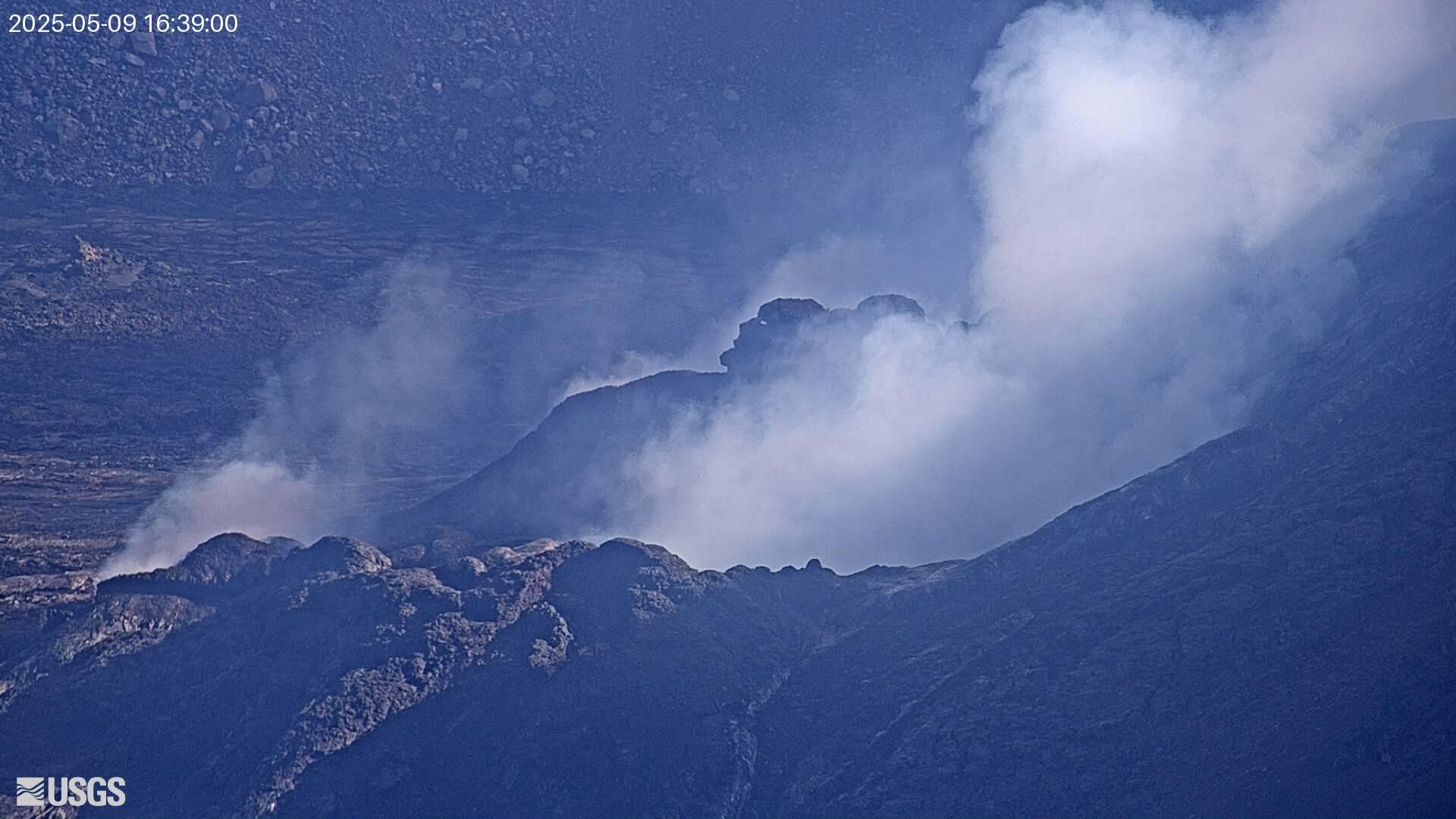
V1cam: West Halemaʻumaʻu crater. Image refreshes periodically at source.
Source: USGS Webcams
📷 View all live webcams📐 Summit Tilt: Past 3 Months
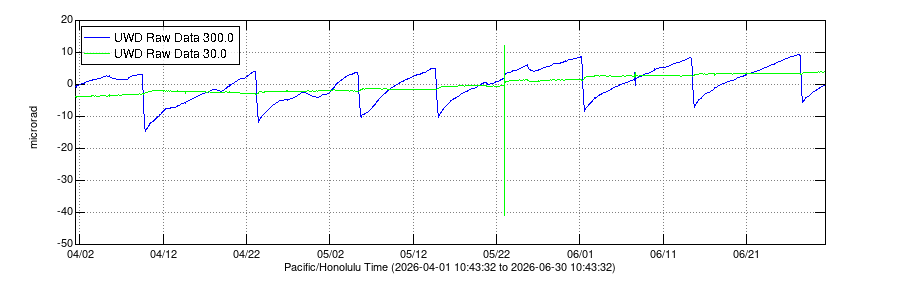
What is tilt? Electronic tiltmeters measure tiny changes in the slope of the ground near the volcano's summit. Think of it like a very sensitive carpenter's level. Learn more about tilt monitoring
Why it matters: When magma moves into the reservoir beneath the summit, the ground inflates (tilts upward). Rapid inflation often precedes eruption episodes. Deflation during eruption shows magma leaving the reservoir. The pattern of inflation → eruption → deflation repeats with each fountaining episode.
Source: USGS Monitoring Data
📊 Timeline of Eruptive Episodes
| # | Start (HST) | Duration | Height (m) | Vol (Mm³) |
|---|---|---|---|---|
| 54 | August 25, 2026 - 10:30 a.m. | 9 hours | 150 | 4.0 |
| 53 | August 12, 2026 - 3:45 p.m. | 10 hours | 150 | 4.6 |
| 52 | July 28, 2026 - 7:10 p.m. | 7 hours | 150 | 4.7 |
| 51 | July 15, 2026 - 8:30 a.m. | 8 hours | 290 | 5.1 |
| 50 | June 27, 2026 - 10:10 a.m. | 7 hours | 300 | 4.9 |
See every episode with fountain heights, volumes, and rankings
Source: USGS Eruption Information. All times HST. Data preliminary and subject to revision.
❓ Frequently Asked Questions
When is the next Kīlauea eruption?
Kīlauea is not erupting. Episode 54 ended at 7:33 p.m. HST on August 25, 2026, and the volcano is in a pause between episodes. USGS has not published a window for the next episode yet. Scientists estimate these windows by tracking summit tilt, seismicity, and GPS ground deformation. The live forecast module above updates every 10 minutes from USGS HVO data.
Is it safe to visit during an eruption?
What closes, what vog does, and whose guidance counts.
Where can I see the eruption?
The overlooks that face the crater, and why people stay past sunset.
How do scientists predict eruptions?
Tiltmeters, quakes and gas, and why the window is days, not hours.
Learn about eruptions, planning a visit, safety, and more
View FAQA clear night here is also a Mauna Kea night. Check tonight's stargazing conditions
Getting in the water on this trip? Big Island surf by shore and beach advisories
The vog on the Big Island comes from this eruption. See today's air quality by town